
Reviews & Articles
Visiting the National Security Exhibition at the Hong Kong Museum of History
John BATTEN
at 1:39pm on 26th April 2026
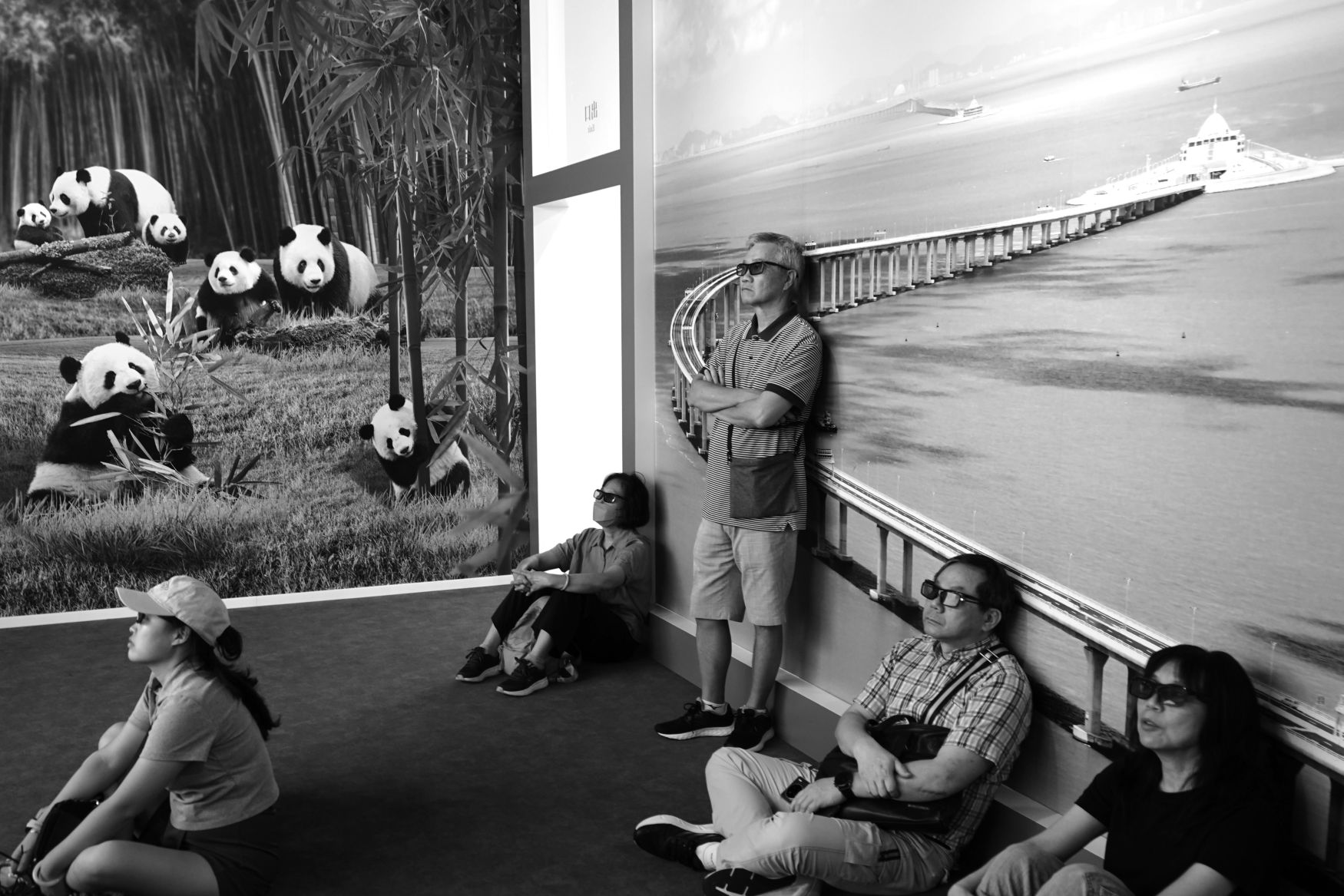
Above image: The audience watches a 3D film at the the National Security Exhibition just prior to exiting the exhibition, 20 August 2025 (photo: John Batten)
(This article outlines the origins of China's national security concerns and gives an overview of the National Security Exhibition at the Hong Kong Museum of History)
Visiting the National Security Exhibition at the Hong Kong Museum of History
by John Batten
Humiliation can be a long-remembered emotion. In today’s China, the country's 19th and early 20th century colonial and national humiliations are never forgotten. Underlying much of China’s continuing engagement with the world and its own people is the memory of the country’s political and economic weaknesses during the slow demise of the Qing dynasty and amidst the turmoil of the Republican period.
On 1 October 1949 overlooking Tiananmen Square, Mao Zedong spoke about the country’s recent history that allowed European-imposed unequal treaties, Japanese invasions, diminished sovereignty and colonial exploitation. He vowed that China wouldn’t allow it to happen again. With these words a fundamental policy of protecting the country was established and has been upheld since.
Chinese border security was immediately threatened after the end of the Chinese civil war in 1949. The communists may have been the victors, but a domestic adversary - and a potential stepping-stone for other aggressors – was now on the mainland’s doorstep after the Nationalists fled to Taiwan. And for many years after the Nationalist’s defeat, insurgency by former Nationalist-aligned militia continued, especially along southern China’s Yunnan province’s porous border with neighbouring countries. The British presence in Hong Kong during the Cold War allowed another potential border weakness for China. The Hong Kong-China border was seen by both sides as vulnerable and volatile – border police and army skirmishes did happen, and deaths occurred. The Tibetan plateau, adjoining China’s sub-continent neighbours (India and Nepal) and central Asia borders, was ‘secured’ in 1959, forcing the Tibetan Dalai Lama to flee and settle in India. Seen by the Chinese as a “splittist”, the Dalai Lama represents the religious and political independence of Tibet, an assertion that China rejects through interpretation of its historical authority over Tibet.
Also, a major defining event immediately after 1949 was Chinese and Soviet (Russian) troops fighting alongside North Korea in the Korean War against South Korean and United Nations forces. The U.N. force mainly comprised U.S. troops, supporting U.S. Cold War containment policies. One of the bloodiest wars ever, millions of civilians on both sides perished and Chinese troop casualties were high. Mao Zedong’s eldest son, Mao Anying, died in the Korean War.
Since the signing of the Korean Peninsula Armistice ended wartime hostilities in 1953, North Korea has provided a useful buffer state for China and ensured it as an ally. The continuing animosity between the two Koreas has given China - importantly acknowledged by the West – some calming influence over the North. In contrast, the Chinese have historically been wary of the Russians.
Japanese wartime atrocities are remembered, commemorated and taught in the mainland school curriculum and in official histories and commentary about the period. Anti-Japanese sentiment is periodically officially encouraged, notably when Japanese government ministers visit Tokyo’s Yasukuni Shrine that commemorates over 2 million Japanese servicemen and women who died in wars after 1868. Controversially and further raising Chinese ire, 1,006 convicted war criminals are also commemorated at Yasukuni.
Only some of this background history is explained in the National Security Exhibition Gallery at the Hong Kong Museum of History in Tsim Sha Tsui East. The focus of this elaborate exhibition is to emphasise that national security is the protection of China’s sovereignty, stability and national borders, and that it covers many other potential vulnerabilities, not just military. As explained by the museum, the exhibition's intentions are to encourage national cohesion by:
"...impressing upon all citizens their duties and responsibilities in safeguarding national security, as well as deepening the community's general knowledge and understanding of national security related concepts and issues. Developed around the core of a holistic approach to national security, the Gallery serves to promote patriotism and affection for our country. Messages are conveyed to encourage all citizens to take part in safeguarding national security, and to elevate their sense of responsibility and ownership. The overarching need for long-term security and stability in Hong Kong, and Hong Kong's unique advantages of being backed by the Motherland and connected to the world are emphasised...."
Opened in August 2024, the exhibition is organised by Hong Kong’s Committee for Safeguarding National Security – supported, of course, by the Liaison Office and the central government’s Office for Safeguarding National Security. The Hong Kong government’s increasingly overt promotion of national security followed the promulgation of the National Security Law in 2020 by the Standing Committee of the National People’s Congress, a law introduced in response to Hong Kong’s anti-government protests of 2019.
National security, however, has been an important tenet of Xi Jinping’s administration since the earliest days after his elevation as general secretary of the Chinese Communist Party (CCP) and chairman of the Central Military Commission in 2012. In 2014, Xi announced a comprehensive national security policy, and over the following years most areas of Chinese life, including media freedom, artistic expression, corruption, the economy and business have been significantly tightened, often in the name of national security.
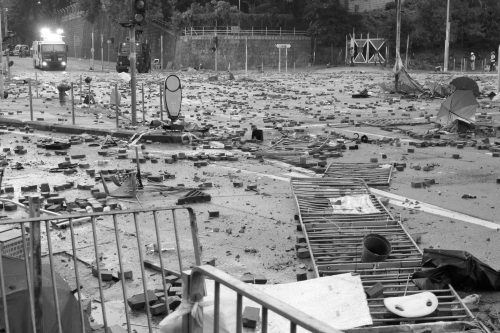
Road after a confrontation between protesters and police. Seen are police vehicles outside The Hong Kong Polytechnic University (and People's Liberation Army's Gun Club Hill Barracks - top right), corner of Chatham Road South & Cheong Wan Road, Tsim Sha Tsui, Kowloon, Hong Kong, 17 November 2019 (photo: John Batten)
In the exhibition, a range of vulnerable areas are succinctly identified as a potential threat or weakness for the country’s security. Twenty areas of national security have been identified and are displayed in sections in the exhibition. Viewers will be surprised by the range that the CCP believes national security covers. Military, economic and political security are foremost, but equally highlighted are: food security, data security, cultural security, ecological security, resource security, outer space security, deep sea security and even polar security, including Antarctica.
On arrival, the audience sits in a cinema-like space watching an introductory video, a prelude to the physical exhibition. The original opening video, seen in 2024, was very short and merely extolled the strengths of China. The current video is a more informative, documentary-style video, often using selective TV news footage from Hong Kong's 2019 protests to demonstrate and argue that a strong police response to protests and the introduction of national security legislation was necessary to stabilise Hong Kong. Uncompromising in its condemnation of “black-clad” protesters, this video will be viewed as propaganda by some visitors wishing a more balanced analysis.
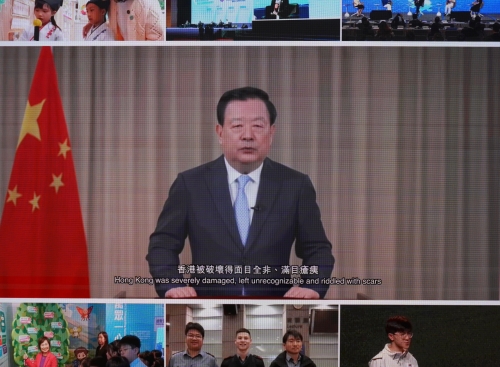
Xia Baolong, Director of the Hong Kong and Macao Work Office, introducing the National Security Exhibition on video at the Hong Kong Museum of History, 2025 (photo: John Batten)
After the introductory video, the audience enters the exhibition area which begins with a brief historic overview: explanatory text and displays, such as facsimiles of China’s ‘unequal treaties’ alongside a replica of the historic painting of Mao addressing the people at the promulgation of the People’s Republic of China in 1949. Then, the exhibition is divided into individual displays of different national security concerns.
Displays devoted to the 2019 protests show images and videos of protesters, the police, mass protests and the damage inside the Legislative Council and MTR stations. Props on display include full armour-clad police gear, police signage, and weapons used by protesters. This is a surprisingly frank display, but, of course, evidence from the 2019 protests is available from the internet and archived newspaper reports. It is still fresh in Hong Kong residents' memories. The argument presented is that that the protests threatened the stability of Hong Kong and the nation.
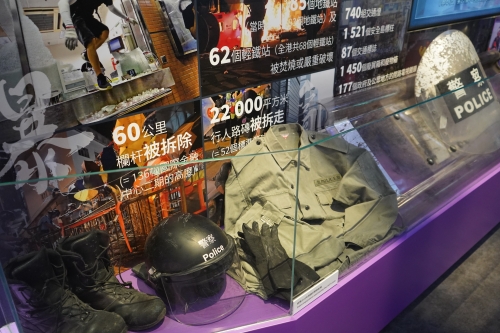
Police gear used during the 2019 protests on display at the National Security Exhibition, 2025 (photo: John Batten)
A sense of national pride and the CCP’s historic place to lead, protect and uphold the continued development of the motherland is presented throughout the exhibition.
National Security Exhibition at the Hong Kong Museum of History information:
|
|
|
|
|
|